If Flight #3 was the calm, confidence-building morning session, Flight #4 — same afternoon — reminded me that experimental test flying keeps you humble. We got up, noticed something electrical wasn’t quite right, came back down, pulled the cowl, and figured it out. That’s the program, and the Garmin G3X makes this kind of detective work so much easier.
I’m sharing the full data and photos below in case anyone else has been down this road with their IO-540 alternator installation — and I’d genuinely love to hear your thoughts in the comments.
The Setup: Two Flights in One Day
Flight #3 happened early that same morning at KHEF — a roughly two-hour session that went really well. First flap deployments, west-side practice area, calm winds. You can watch the Flight 3 footage here, which covers that morning session right before this one:
By evening I was back at the airport for a second bite at the apple. The controller on duty hadn’t seen our experimental test program before, so we had a good chat on the radio about the practice area setup. During the run-up I noticed the mag drop on each side — left conventional magneto and right SDS CPI-2 electronic ignition — was running around 160 RPM per side, a bit more than I’m used to from my RV-7 background.
Mag drop of ~160 RPM per side with a conventional mag on the left and SDS CPI-2 on the right on an IO-540. Does that sound about right for this combination? I’d really appreciate a comparison point from other builders running this setup.
The Takeoff Smell — and the First Clue
Takeoff on 16L was otherwise normal. Almost immediately after rotation I caught a mild burning smell — subtle, but on a 4th-flight experimental you don’t ignore subtle. I knew we had a small burn spot on the cowl interior from an earlier exhaust pipe contact (now protected with aluminum foil tape and the pipe repositioned), so it might have been residual. But then the electrical picture started to change.
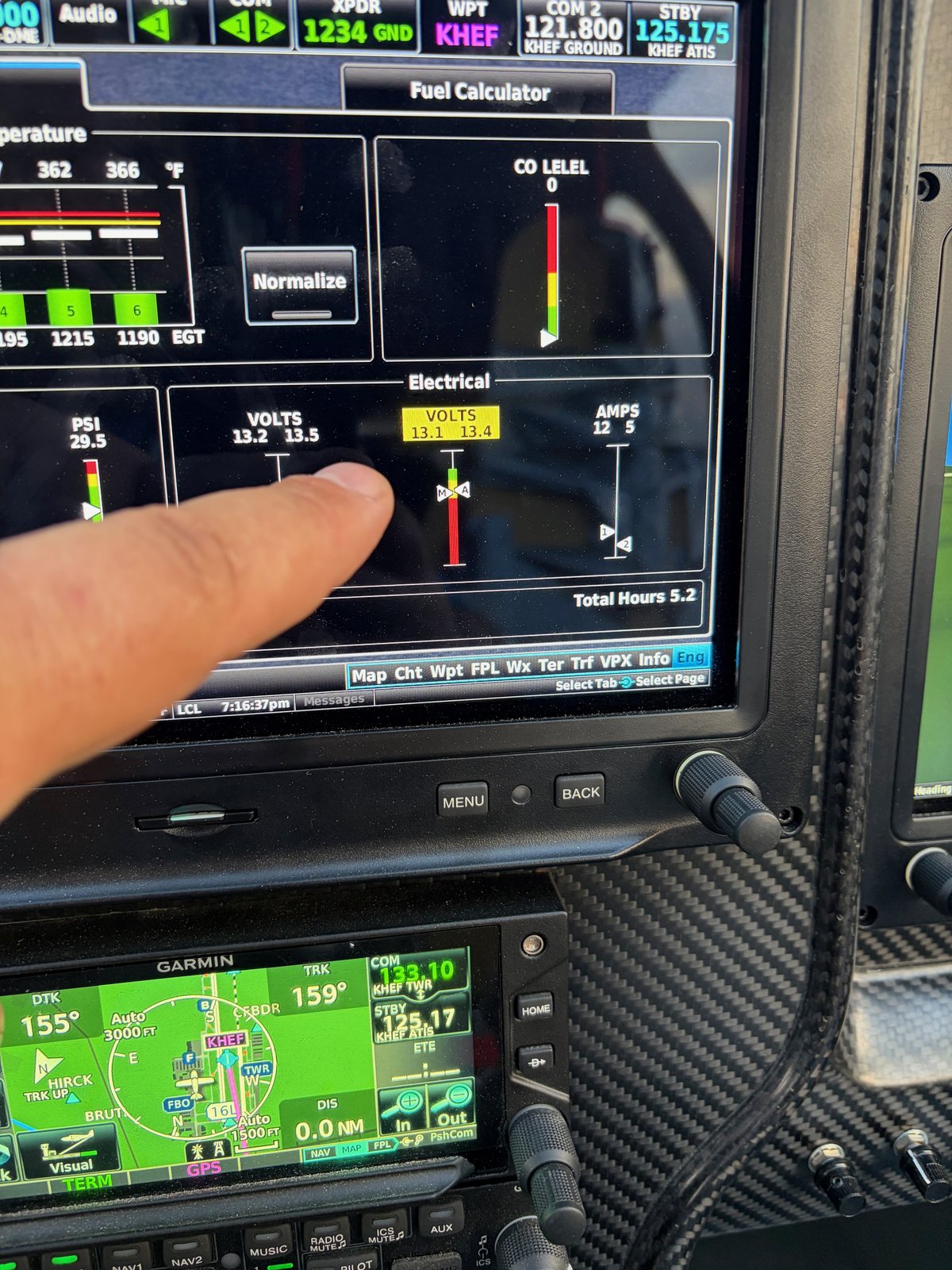
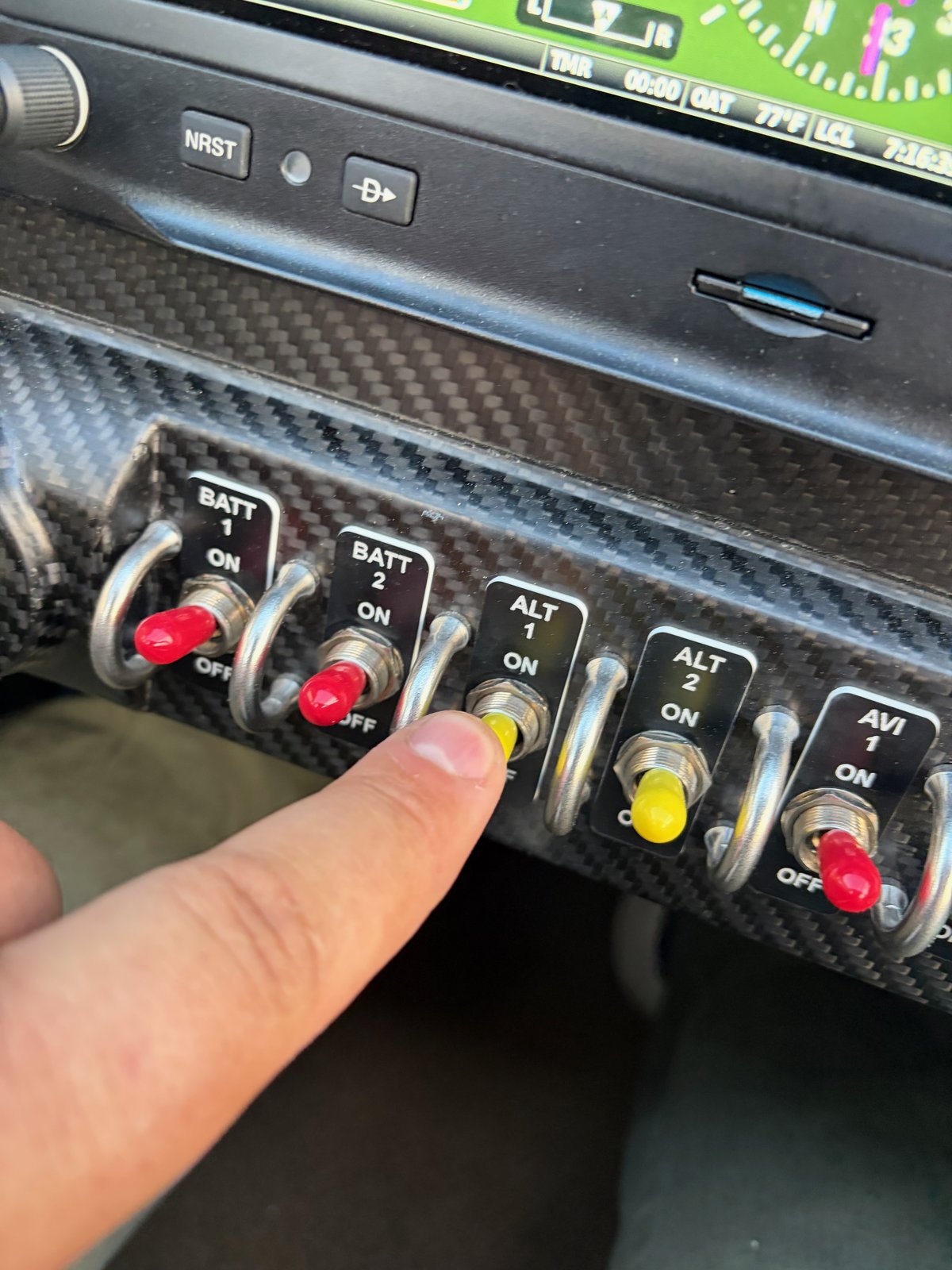
Normally Alternator 1 carries the bulk of the load and Alternator 2 handles residual backup loads. On this flight, Alt 1’s ammeter dropped into single digits — well below what the aircraft was actually drawing. Battery 1 was starting to discharge. Cycling the ALT 1 switch would briefly coax it back, but it wouldn’t hold normal output.
What the G3X Data Shows
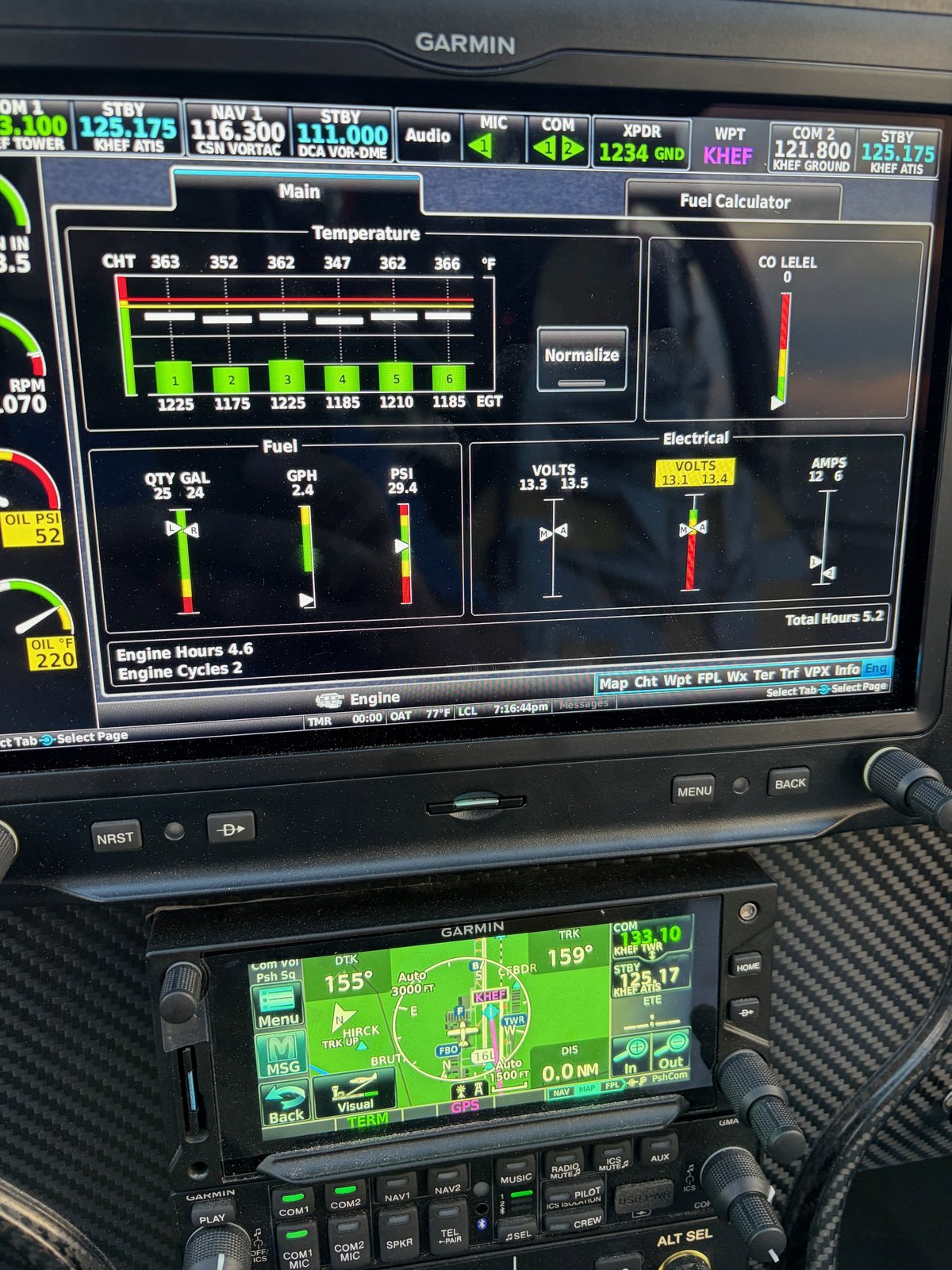
This was a short flight — about 13 minutes airborne, max altitude 2,031 ft MSL, max IAS 166 kts. But the electrical log tells the story clearly. Bus 2 held solid at 14.1–14.2V throughout; Bus 1 steadily lost ground as Amps 1 faded from 28A to just 4–5A while Battery 1 discharged.
| Time | Bus 1 Volts | Bus 2 Volts | Amps 1 | Amps 2 | Alt (ft) |
|---|---|---|---|---|---|
| 19:00 | 13.5 | 13.9 | 28 | 25 | 298 |
| 19:01 | 13.5 | 14.0 | 24 | 21 | 1,138 |
| 19:02 | 13.4 | 14.1 | 22 | 16 | 1,629 |
| 19:04 | 13.2 | 14.2 | 13 | 10 | 1,722 |
| 19:06 | 13.0 | 14.2 | 5 | 9 | 2,009 |
| 19:08 | 12.9 | 14.2 | 4 | 9 | 1,936 |
| 19:10 | 12.9 | 14.2 | 4 | 9 | 1,083 |
The decision to return was easy: no imminent emergency — Battery 2 and Alt 2 were healthy, and Battery 1 still had reserve — but continuing to discharge an unknown cause wasn’t prudent at this stage of testing.
Engine Temps: CHTs and Oil Temperature
While the electrical issue was the main story, I was watching engine temps closely too. CHTs peaked at 441°F on CHT-1 this flight, with cylinders 1, 2, 5, and 6 still running warmer than 3 and 4 — a consistent pattern since Flight #1 that seems to be gradually improving with each flight. Cylinders 3 and 4 are now comfortably below 350°F in cruise, which is encouraging.
Oil temperature came in at 215–220°F at taxi-in after landing — higher than I’d like, though this was after a high-power takeoff and immediate return to land with very little cruise cooling. We also found the oil cooler airflow door wasn’t quite at 90° open (the winter-operation door should be fully open in summer), so we straightened it. We’ll see if that makes a difference on the next flight.
The Post-Landing Find: Alternator Belt
After landing we pulled the cowl. The culprit was immediately apparent: noticeable slack in the alternator belt. Not a broken belt, not a failed regulator — just insufficient tension. Both the main lower pivot bolt and the smaller tensioning bolt were intact and the tensioning bolt was still safety-wired, but the belt had clearly stretched or the alternator had shifted slightly.
We loosened both bolts, used a screwdriver to lever proper tension back into the belt, re-tightened everything, and re-safety-wired. The intermittent charging behavior in flight — briefly recovering when I cycled the switch, then dropping off again — makes perfect sense in hindsight: the belt was marginal and slipping under load. I’m relieved it wasn’t a chafed or burned wire. Battery 1 went on the wall charger overnight.
The belt seemed fine at install and through the first three flights. Did it stretch after initial heat cycling? Is there a recommended belt tension spec or a “check after first N hours” item for the Lycoming IO-540 alternator drive I should be following? Would love to hear from anyone who’s been down this road.
Oil Cooler Door — Another Small Fix
As noted above, we found the oil cooler winter-operation door sitting at slightly less than 90° open, potentially restricting airflow to the cooler across all previous flights. We adjusted it to fully open. With the shorter flight profile and high-power takeoff, the 220°F oil temp is plausibly explained by the flight itself rather than restricted airflow — but the door is now confirmed fully open and we’ll have cleaner data going forward.
The Landing: A Real Improvement
Not all problems this flight. The full-flap landing at the end of Flight #4 was noticeably better than the steep close-in approach at the end of Flight #3. In Flight #3 I was at virtually full aft stick at roundout with nothing left in reserve — the RV-10’s limited elevator authority at forward CG with full flaps on a steep approach is a real thing.
For Flight #4 I used a much shallower approach angle, carried a touch more power, kept the nose slightly higher, and touched down at about 64–65 knots indicated. The flare felt natural and in-control. This will be the approach profile going forward.
Note on CG: Flying a fairly forward CG for these initial flights — intentional for early test stability — with ballast in the rear seats to nudge it back slightly. Limited elevator authority at forward CG + full flaps + steep approach is a documented RV-10 characteristic. Curious how others have managed approach technique in this configuration during early flights.
Items Still on the List
AHRS 1 tumbling on takeoff: PFD-1’s artificial horizon tumbles consistently when I apply takeoff power — every single flight. PFD-2 stays solid so it’s not a safety issue right now, but I want to understand it. Vibration? Connector seating? Has anyone seen this in a G3X installation?
CHT temperatures: Still watching closely. Peak temps hit 441°F on CHT-1. The hotter cylinders (1, 2, 5, 6) seem to be gradually trending down with each flight as the rings seat. Hoping to see all six under 400°F in level cruise before long — does that sound like a realistic expectation at ~4.5 engine hours, or should I be looking at baffling adjustments?
Fuel float gauges: Still getting hung up at the full position. Not urgent since the totalizer is primary, but the mechanical float/wire fit issue inside the tanks needs to be addressed eventually.
What’s Next
Before Flight #5: re-verify alternator belt tension and confirm Alt 1 charging properly on a ground run. Assuming that checks out, the goal is continued envelope expansion — more time at altitude, more cruise data, and continued CHT monitoring as the engine breaks in.
Your turn: If you have experience with alternator belt tension on Lycoming IO-540 installations, SDS CPI-2 mag drop numbers, G3X AHRS tumbling on takeoff, CHT break-in patterns, RV-10 approach technique with forward CG, or oil cooler management — please drop a comment below. Whether you’re an RV builder, an A&P, or just following along, your input is genuinely welcome here.
Please join the discussion or send feedback here: VAF Thread — RV10 N997CZ Takes to the Skies
 jamessclarkiv.com
One thought on “Flight 4: N997CZ — Alternator Belt Blues (and a Better Landing!)”