Replacing top spark plugs

After talking with Nabil yesterday, he confirmed that the new spark plugs that I had purchased in bulk a while back were indeed OK to use in this engine. When I was removing and gapping the spark plugs a while back, I wanted to replace them just to be sure, but the new plug tips were different from the old ones, so I waited.
IMG_1296

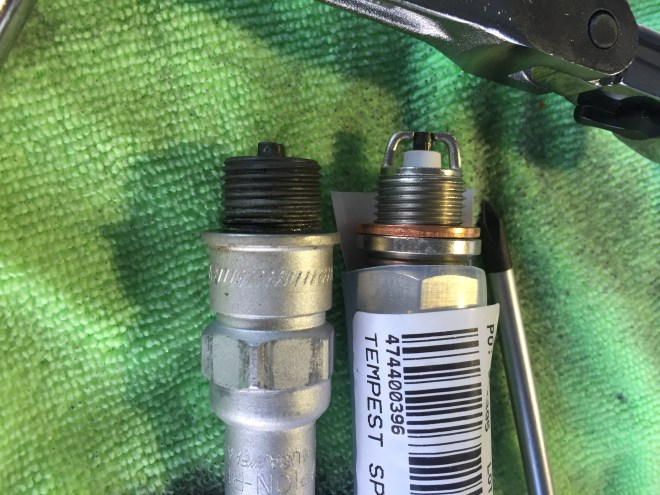
Today I replaced the original Champion REM38E with Tempest (formerly Unison) UREM37BY in the top 4 spark plugs. I torqued to 30-35 foot-lbs (360-420 in-lbs). I used oil instead of anti-sieze this time.

LycomingSparkPlugs

I started the engine and flew for two touch and goes. The engine started nicely…but will see if this is consistent. On the 2nd touch and go, touchdown cracked the right wheel pant fairing…same thing that happened in the past to the left wheel pant fairing. The holes in the bottom of the wheel pants were not carved out enough, so when the wheel compresses and bulges in just the right way, it catches the rear lip of the wheel pant and breaks out a chunk of fiberglass. I heard the rubbing right away after touchdown and aborted the takeoff part of the touch-and-go. I taxied back and sure enough, now I have two cracked wheel pants.

I removed all 3 wheel pants, applied fiberglass and epoxy to the two main pant rear halves to fix the cracks, and will plan to carve away more fiberglass for clearance when they dry. I also removed the wheel pant fairings, gear leg fairings, and upper intersection fairings to take home for paint or vinyl.

I also removed the left wing tip to investigate why my left landing light (HID) had stopped working. I confirmed that power was being delivered all the way to the wing tip. I removed the right wing tip bulb and connected it in the left wing tip HID ballast. No light. I connected the left wingtip bulb to the right wingtip ballast and it lit. Thus both bulbs work and the problem is in the left wing HID ballast unit. I reinstalled the right wing bulb and right wing lens cover, and removed the left wing ballast, and left wing bulb. I reinstalled the left wing tip and the left wing lens cover.
Engine Maintenance

A few weeks ago while searching for a possible cause for my slightly elevated CHTs, I decided to re-check the engine timing. This was at about Tach: 91.6, Hobbs: 102.2. The timing had drifted from 25 BTC to 27 BTC on one mag (didn’t record which) and 25 to 29 BTC on the other mag. Resetting this to 25 & 25 helped cool the CHTs on subsequent flights, but the engine became more difficult to start when cold (maybe unrelated). Since removing & gapping the lower plugs to 0.016 (earlier entry) seemed to help with the subsequent cold start (may be my imagination), I also removed and gapped the upper plugs (earlier entry) to 0.016. Subsequent starts did not seem to improve in difficulty. I’ve tried various combinations of priming durations and no longer suspect it is a rich/lean mixture thing, rather a weak spark on left (starting) impulse coupled magneto.

Yesterday, a very experienced aviation maintenance technician stopped by (Nabil) for over an hour to help me trouble shoot. He wanted to confirm several things before agreeing with me that the mag spark was weak. First we removed top 4 plugs and re-checked the timing. He agreed it was correctly timed at 25 BTC on both mags. He was also suspicious of my left&right independent DPDT mag switches (since I used the 2nd poles to route my starter relay wire to prevent starter engagement with any combo other than left mag on, right mag off). He wanted to verify that the mag timing box lights didn’t change when pressing the starter switch (they shouldn’t and didn’t). Since the prop cranks with gusto when starting, and coughs several times before catching, he finally agreed with my diagnosis that it could be a weak spark from the left mag. Still seems strange since after start, all running is beautiful and mag drop checks are OK at 1800 RPM with engine slightly leaned from rich (140L drop/150R drop). I understand 175 max drop and 50 differential is the Lycoming limit.

He offered several ideas: Buy new left impulse coupled mag…he estimated $900. Send left mag out for inspection and overhaul…he estimated $300-600. I said what about buy new P-Mag EI for left mag replacement (more expensive and reputed to be much less dinosaur technology with much hotter spark and easier starting). His opinion was that was “too advanced technology” that didn’t belong in this style plane/engine…I let that one go by. He also was a fan of eventually replacing the right mag with an impulse coupled mag also since that would allow me to wire for starting with both mag switches on. I was very grateful for his help and learned a bunch. He wasn’t charging, but I figure I will buy him a six pack.


Cleaning & gapping upper spark plugs

8/14/16, Tach: 93.9, Hobbs 105.0

The engine seemed a little easier to start so I decided to also clean and gap the top spark plugs. Once again, all measured > 0.022 on the feeler gauge. I reset all 4 to 0.016.

I also measured the spark plug resistance: #1: 730 ohms, #2 680 ohms, #3 710 ohms, #4 760 ohms. This seems good. The spark plugs that are currently installed top/bottom are the original (came with engine) Champion REM38E (massive electrode). I used new copper gaskets on each.

Cleaning & gapping lower spark plugs

8/13/16, Tach: 91.6, Hobbs:102.2

Cleaned and gapped 4 bottom spark plugs since the engine has gotten harder to start. This difficulty to start (now when cold) seemed to occur right after re-setting the timing to 25 BTC on each mag. On the prior maintenance, i noticed the timing had drifted to 27 BTC on one mag, and 29 BTC on other mag. Resetting this to 25 & 25 did make an appreciable difference in lowering my CHTs (TODO: find dates & download before/after logs).

I borrowed Adrian’s gap measuring tool (TODO: buy), and all 4 plugs were worn (or were never originally set) to gaps larger than 0.022. The acceptable range is 0.016 to 0.021. Some folks have said plugs wear 0.001 to 0.002 in 100 hours. This would seem to indicate mine were not gapped to start with or they wore very fast.

Flight #22

6/2/16

Added 40 more pounds of water. This time to the baggage compartment. I’m walking the CG backwards a bit at a time from the 80.04 empty to the rear limit of 86.8. Takeoff for this flight was CG=84.3.

Basic Empty Weight LBS Arm Moment
Left Main

435

93.96

40872.6

Right Main

435

93.96

40872.6

Nose Wheel

296

39.11

11576.6

Empty

1166

93321.8

Empty CG

80.04

Max Limit LBS

1868.0

Max Limit Aero

1600.0

CG Limit Min

78.7

CG Limit Max

86.8

CG Limit Max Aero

84.5

Pilot Station

97.5

Passenger Station

97.5

Main Gear Station

94.0

Nose Gear Station

39.1

Fuel Station

80.0

W&B this flight @ takeoff:

Full Dummy 3
Empty Weight

1166

93321.8

Pilot

250

97.48

24370.0

Passenger

80 Water

97.48

7798.4

Fuel

252

80.00

20160.0

Baggage

40 Water

126.78

5071.2

Weight

1788

150721.4

CG

84.30

Left Main

736.5

Right Main

736.5

Nose Gear

315.0

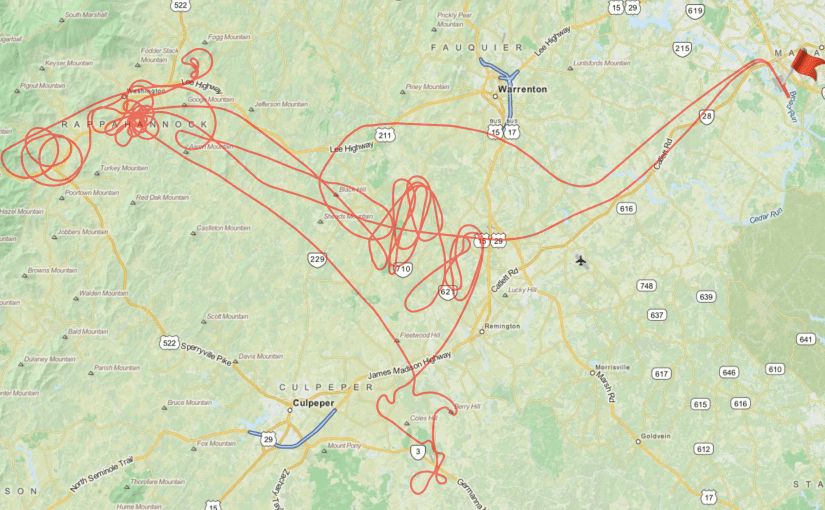
Due to a visual on heavy rain to the west, decided to takeoff and stay in the pattern for 30 minutes. After 30 minutes of doing 8 takeoffs and landings in the pattern, it appeared the rain wasn’t moving in or getting any worse so I picked up the flight plan and departed to the west. Wind was from the east and keeping the rain to the west from approaching. Experienced rain in the RV for the first time deliberately during this flight since I could dart into and out of the showers (this was light rain falling from clouds high above). No apparent leaks. Flew along the edge of a line of rain with clear to the east (Fredericksburg) and rain showers to the west (Madison/Greene). Darting to the North allowed me to get out over Rappahannock to the west and circle Mom’s house for a bit.

Upped the G’s to 2.83 G’s max during a few maneuvers.

Times: 33.4/36.1 Before; 36.3/39.1 After

Flight Data

Flight Map

Rain pictures from the flight:

W&B @ Landing:

Landing Dummy 3
Empty Weight

1166

93321.8

Pilot

250

97.48

24370.0

Passenger

80

97.48

7798.4

Fuel

73.8

80.00

5904.0

Baggage

40

126.78

5071.2

Weight

1609.8

136465.4

CG

84.77

Left Main

670.1

Right Main

670.1

Nose Gear

269.7

Flight #21

6/1/16

Preflight, removed front air dams in front of the #1 and #2 cylinders. Still missing air inlet ramps. 80 lbs water in the passenger seat.

Starting Fuel: 40

Starting Time: Engine: 31.6, Total: 34.2

Flight Data

Flight Map

Increased G loading to ~2.7 G’s

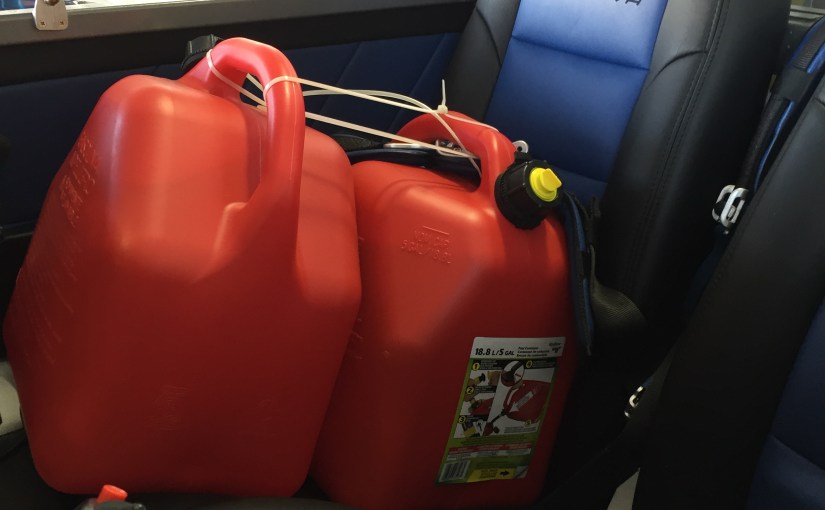
Flew with 80 lbs in the passenger seat (2x 5 gallon jugs of water)

Ending Time: Engine: 33.4, Total: 36.1

Totalizer: 19.3 Used, 20.7 Remaining

Dip 11L/10R

Fill 18.9 Total

Flight #20

Preflight: Removed elevator bell crank inspection ports on both sides to inspect the elevator push/pull tube, jam nut, and bolt holding the elevator horns together. All was nominal. Added torque seal to the jam nut and elevator horn bolt so I can see if it ever moves. Reinstalled two inspection ports (7 #6 screws each).

Fuel starting was 20L/20R. Totalizer remaining: 40.

Oil was above 6.0.

Preflight: Engine: 29.9, Total: 32.4

I installed the passenger seatback which had been removed for many flights. I filled a 5 gallon gas jug with water (40 lbs), and strapped it to the passenger seat. Slowly beginning to increase the weight to explore the CG envelope. I did some stalls at 0, 1/3, 2/3, and Full flap settings near the beginning of the flight while the tanks were still relatively full. The stall behavior is slightly sharper, but still very benign. The AoA audio tone warning beeps are now active since I calibrated the AoA gauge last flight and it is a very nice feature.

I also spent a bunch of time leaning the engine and watching EGT readings…see the flight data link below and plot EGT, RPM, FF, and MAP.

Post flight: Engine: 31.6, Total: 34.2

Time: Engine: 1.7, Flight: 1.8

Fuel ending was: Gauge: 15L/13R. Dip 12L/10R. Fill: 7L/9.9R (16.9 total)

Fuel totalizer used: 16.9

Remaining: 23.1

Flight Data

Flight Map

The totalizer seems to agree well with the fuel truck. The gauges seem to read 2-3 gallons too high in the mid range.