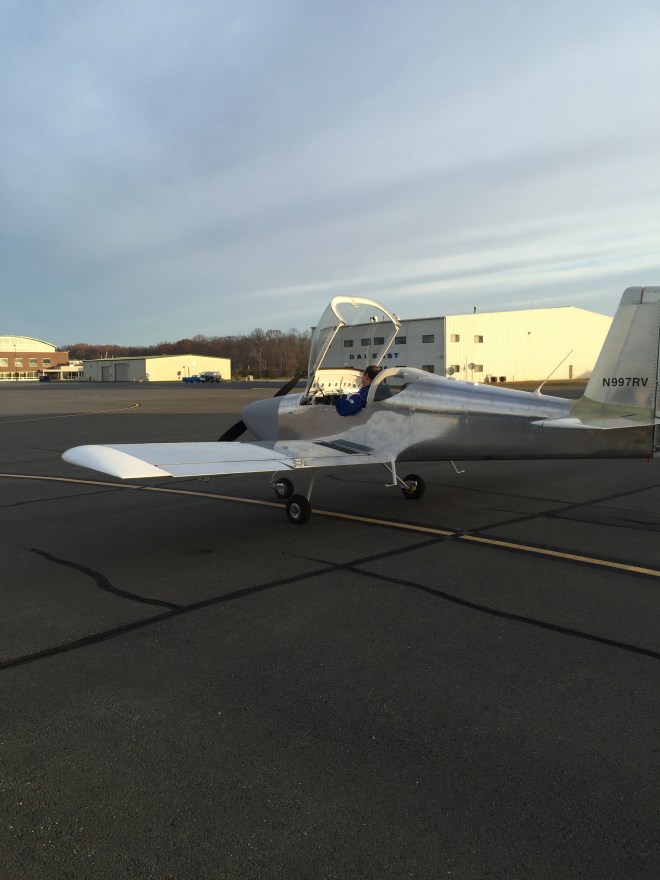
Flight #2

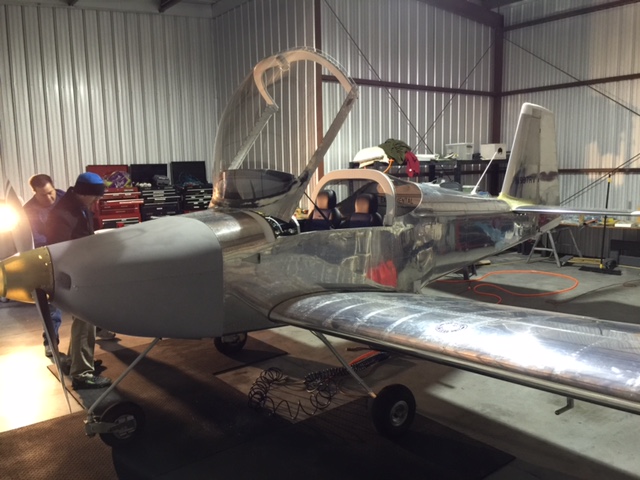
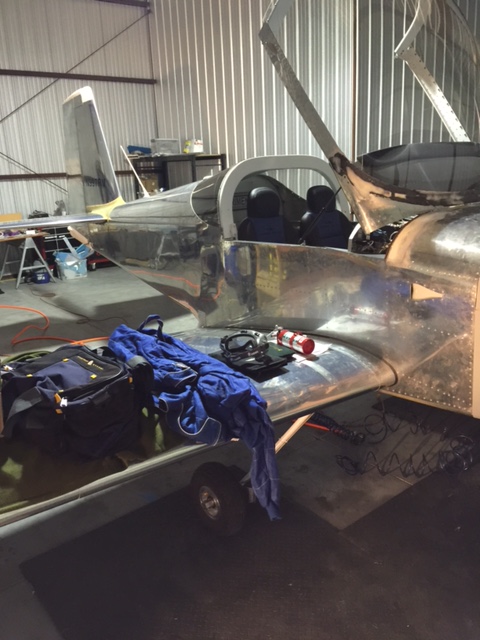
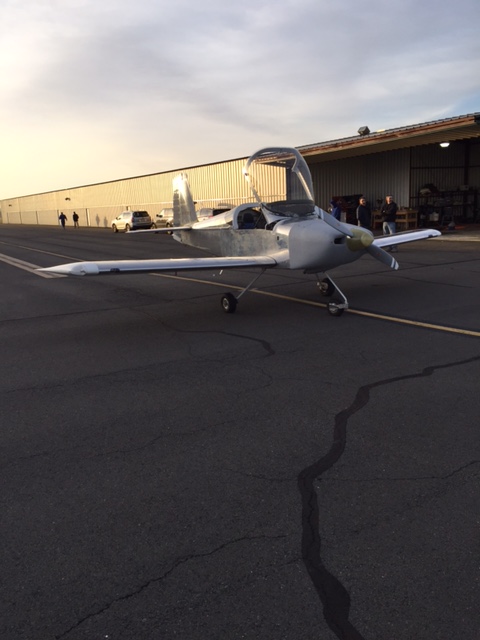
Once again I had a nice group of friends willing to support this flight by acting as ground crew. Dave, Alex, & Lisa Haschart, and Bruce Anderson, joined Rachel, Zack, Mom and me at the airport at 7AM on Saturday.

We didn’t have the fire axe or rescue squad folks on hand for this one so we were missing the fire axe and sawzall, but felt comfortable proceeding based on the success of the first flight.

Once again, flight #2 was to be a trip around the local airport pattern at Manasssas VA. However, this time I was flying ~155 KIAS instead of the ~105 KIAS from first flight.

Departure was around 07:45. Tower had me make left traffic from runway 34R which was a bit unusual, but posed no problems and let me fly larger laps around the west side of the airfield. I spent about 1:30 in the air.

Dave was kind enough to send me this video of the takeoff:

This flight included a fuel tank change every 30 minutes, and I started on the left tank which had been tested during the first flight. No noticeable effects in fuel pressure or fuel flow when changing tanks for the first time. I did not use the boost pump during switches.

Dave also sent this video of the taxi in after landing:

After taxi in and de-cowling, we checked/noticed the following items:

Brakes were good but reservoir leaked another ~1oz.

Right Tank Dipstick Measurement: 12 Gallons Remaining (Gauge = 14 gals)

Left Tank Dipstick Measurement: 7 gallons remaining (Gauge = 8 gals)

Oil: 6.1 Quarts

Fuel Flow Totalizer: Fuel Remaining = 16.5 gallons

Fuel Used = 22.5 gallons

Fuel Truck Filling: 23.2 Gallons Added

Right Tank Dipstick = 20.5 Gallons

Left Tank Dipstick = 20.5 Gallons

Wiped brake reservoir but didn’t tighten or fill.

Pulled cowls and checked engine compartment. Added foil tape to bottom of heat scat tube where rubbing cowl. Still need permanent fix.

Flight Temps & Parameters: Flight 2 Data

Flight Map: Flight 2 Map


Flight #2 Prep Work

Today I installed the GoPro camera via a suction cup mount hanging from the canopy ceiling on the passenger side. I did not yet hook up the audio/power cable as I don’t have a skeleton case that allows the mount and the cables at the same time.

I checked the oil and measured 6.25 quarts (cold). I noticed minor rubbing between the lower cowl and the heater scat tubes that will need fixing eventually.

I opened the right dash panel to access the IFR GPS (GTN650) antenna cable which had become loose (I think I didn’t screw it in fully originally). This is a type-N or similar connector that screws several turns. I applied a bit of extra torque using a wrench. I checked the IFR GPS and am now getting satellite reception again.

I looked for brake fluid leaks around the right wheel and found none from the brake bleeding #3 yesterday.

I mounted the lower cowl and the upper cowl. I reinstalled the cowl hinge pins (2 side vertical, 2 side horizontal, 2 upper rear, and 2 lower) & 6 retainer screws. I reinstalled the lower cowl retainer plate, 2 washers, and two screws.

Bleeding the brakes again (3rd time)

After my first flight, I noticed the brakes were spongier than before. After de-cowling after the first flight, I found that when I had bled the brakes the 2nd time, I hadn’t gotten the cap on the brake reservoir on the firewall tightened securely enough. During the first flight, some of the brake fluid  (~1 oz) had overflowed the master reservoir and coated the firewall.

Today I attempted to bleed the brakes for a third time (to git rid of the air bubble sponginess I had introduced when bleeding the brakes a 2nd time (to fix the right brake leak). I got several noticeable bubbles out of the master reservoir by bleeding the right brake, and made sure I tightened the cap on the reservoir securely this time.

After standing on the brake pedals on both passenger and pilot sides, it feels like they are once again firm (like they were after the first brake bleeding with Steven). I will check their performance on the 2nd flight, probably this coming Saturday morning.

Sealing the baffles (round 2)

The elevated CHTs on first flight caused me to go back and seal the baffles with even more care. I used EAA tech counselor’s recommendation of siliconized latex caulk to seal the baffles. I hope this stuff holds up to heat the way the tech counselor promised.

First Flight Cylinder Head Temps

During my first flight of 0:28, I flew at reduced throttle settings and prop full forward (high RPM). This is not really recommended for several reasons: 1) the throttle full forward enables an enrichment path that increases fuel flow and helps to cool the engine during breakin, and 2) for engine break-in you want to fly with 65-75% power for the first 5+ hours to ensure you seat the rings. By flying with reduced throttle settings, i bypassed the enrichment circuit and had higher CHTs (or this is my working theory).

The desire is to have CHTs during climb stay below 400 F and CHTs during cruise in the mid 300’s. My CHTs peaked at 434 F during climb and were in the mid 300’s during my low power circuits around the pattern.

On my second flight, the goal is to fly full rich, and possibly pull back on the prop control to keep airspeeds reasonable while still enabling the full throttle enrichment feature. My airspeeds during first flight never exceeded 115 KIAS, but with these settings for my second flight I may see airspeeds > 150 KIAS and will need to be ready for the rapid pace in the KHEF class D (4 nm radius).

It is quite the dilemma for the 2nd flight. KHEF class D has a ceiling of 2000 MSL and 4nm radius. Warrenton airport (8 miles away) is outside the Washington DC SFRA and I could have unlimited altitudes out there. Should I depart the proximity of manassas in exchange for the added safety of extra altitude available near warrenton, but risk the 8 nm flight between the two airports during flight 2? Current plan is to wait till flight 3 for that. I will try to fly flight 2 inside the KHEF class D at higher power settings.

You can see the advice I got from Vans Airforce here:VAF First Flight Post

First Flight

First flight occurred on Black friday, just after thanksgiving 2015. Initial preparations began at 06:30:

image2

I asked my ground crew to arrive at 7AM.

image1

My ground crew for the first flight consisted of my brother Steven, Greg Mitchell (volunteer rescue squad member), Dan Havens (rated private pilot familiar with Manassas airport), and Mark Gramann (good friend in town for Thanksgiving). My wife Rachel and 8 month old Zack were also present.

image3

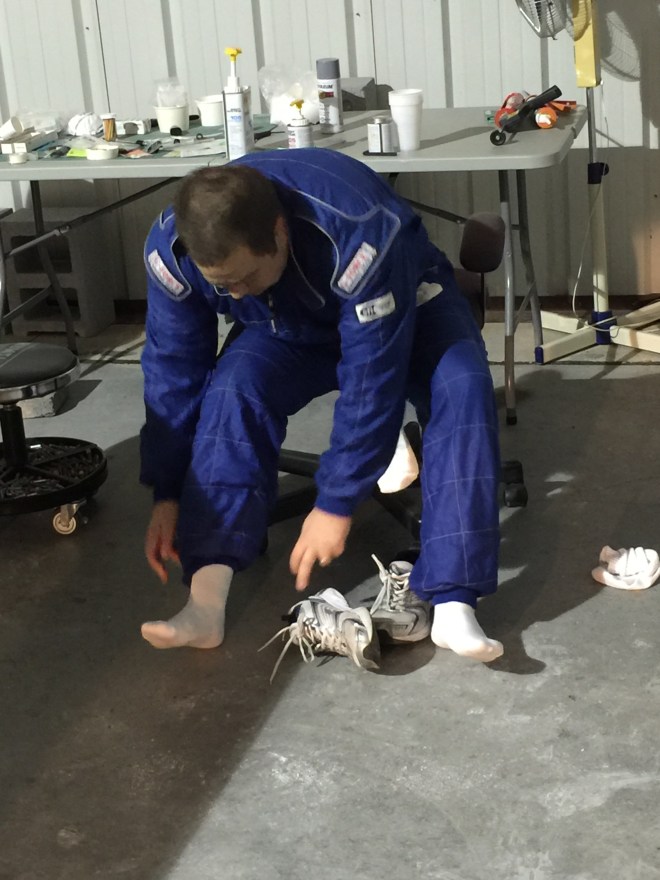
For gear, I wore my road rally racing fire suit, nomex socks, nomex hood/balaclava, work gloves (nomex ones hadn’t arrived), and regular tennis shoes. I carried a 1.3 lb. halon fire extinguisher, a small hatchet (to help if I needed to break the plexiglass window to extricate myself from the airplane), an aviation handheld radio, and smoke goggles in a duffel bag I strapped to the passenger seat.

Ground gear consisted of a 20 lb. chemical fire extinguisher, Greg’s fire axe, Greg’s rescue sawzall (used on car extractions for cutting A/B pillars), a hand held aviation radio, and a 4 wheel drive vehicle.

We performed a preflight briefing and I provided the crew with maps of the airport and surrounding area, local tower and ground frequencies, and a gate card to let in the local rescue squad if required. Greg contacted Manassas City Fire & Rescue and we learned that they knew how to access the airport perimeter and had a 3-5 minute estimated response time to the airport.

image5

image7

Airworthiness Approved!

October 16, 2015

Today I paid a much too large sum of money to a Designated Airworthiness Representative (DAR) to inspect my RV7 and approve my paperwork. The fee was excessive because I wanted the inspector to come with very short notice since I was feeling pressure from the Manassas Airport to complete the aircraft or loose my hangar lease.

I moved into the Manassas airport in June of 2015 after 5+ years on the waiting list. Every 18 months or so, we would come to the top of the list, but each time we weren’t quite ready to make the move. That all changed this June when we reached the top of the wait list for our third time. I felt it was a bit early, but decided to bite the bullet and grab the hanger instead of waiting another 18+ months.

The airport gave me an initial 90 day lease (I asked for 120 days), and stipulated I would need to be airworthy by the end of that period. I knew that would be tough, but we gave it our best shot. As the end of the 90 day window neared and it became apparent we wouldn’t finish in time, I sent the airport a letter showing the 30+ items that had been accomplished and the “5” items remaining to complete. With this letter I asked for a full 1 year lease and as a fall back asked for a 90 day extension. They did neither, but gave me a 45 day extension.

Thus after 135 days in the hanger, I scheduled an airworthiness inspection on short notice with the DAR. Ironically, the day before my airworthiness inspection, the airport granted me my 1 year lease, since it was clear the aircraft was nearly airworthy.