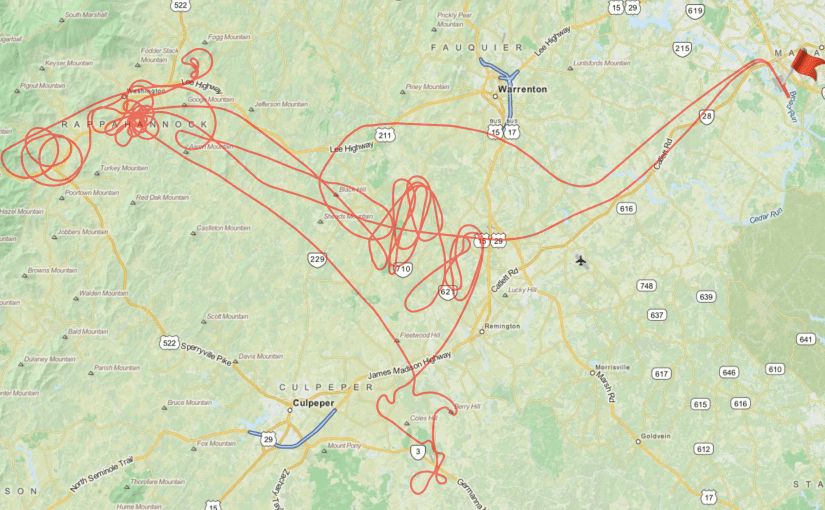
This was the first flight exploring leaning out the engine.
Preflight: Engine: 19.0, Total: 21.6
Post flight: Engine: 20.4, Total: 22.9
Time: Engine: 1.4, Flight: 1.3 (numbers round wierd)
This was the first flight exploring leaning out the engine.
Preflight: Engine: 19.0, Total: 21.6
Post flight: Engine: 20.4, Total: 22.9
Time: Engine: 1.4, Flight: 1.3 (numbers round wierd)
Ok this is driving me nuts. My new RV7A has 20 hours on it, and everything is just lovely…except this darn oil pressure intermittent problem where the oil pressure gauge suddenly pegs off-scale high (data download shows 155 psi, in abrupt change from minutes of nominal readings)
Here is a description, and what I have tried:
First cropped up after ~12 hours on new engine:
Kavlico 150 PSI 3 wire sensor (GND, 5V, signal)
0.5V = 0 PSI
4.5V = 150 PSI
Mounted on transducer block on firewall. Plumbed to the engine with a restrictor valve on the engine side of the hose.
Gauge will read fine: 50-60 PSI during taxi, 70-80 PSI during runup.
It will react normally and then just suddenly jump to 150PSI+. When it jumps there, it usually stays there while I terminate the flight. After engine shutdown, it stays reading pegged 150 PSI+. After avionics power cycle withe engine off, it will sometimes show 150+ and sometimes clear the error and show 0 PSI. If it crops up, it likely crops up in the first 10 minutes after engine start. If it doesn’t crop up, I can fly for 2 hours (2 times) and not have a problem.
The 2nd and 3rd time it happened, I landed, quickly removed the cowl and wiggled wires near the oil pressure sender…no change. I separated the connector near the oil pressure sensor (3 lines) and measured 0V GND, 5.01V, and 4.5 V on the sensor return line (this is with sensor disconnected)…Also, seem to have measured 0V GND, 5.01V and 0V on the sensor return line sometimes when I disconnect it (each time i disconnect, I do see a change from off-scale high to red X on display)…this made me suspect the sensor return line was somehow shorting to the 5V supply, or that it has a pull-up resistor in the G3X GSU73 that is pulling high when the gauge is disconnected.
So I spent 2 hours, digging under the panel and disassembled the connector shell at the GSU73 and checked all wiring…the only wiring i haven’t check is if there is chafing where it goes thru the firewall pass thru since that is covered in fire seal. With the GSU73 connector removed, none of the 3 wires seems shorted to each other.
This leaves me thinking I should try replacing the $90 gauge. but this is weird failure mode right? Could this be a firmware glitch that is solved by G3X firmware update. Could this be an intermittent GND line? When the ground goes away the pull-up brings the line high and thus the off-scale reading?
I also plumbed a mechanical gauge in parallel with the G3X Kavlico sensor, and the readings during a full runup are within 1-2 PSI from 0 to 50 to 80. But, since it seems i need to fly to get the glitch, I haven’t had the mechanical gauge plumbed during any of the actual glitch events. But I’m convinced it is not a real pressure event and it gauge or wiring…
Why would sometimes an avionics power cycle clear the error and return it to 0PSI if it was a wiring problem?
Any ideas would be much appreciated.
5/24/16
Returned to the airport to investigate the oil pressure gauge problem. The goal was to get the sensor to do its off-scale high in the pattern, land, and investigate by probing the wires, switching the gauge plugged in, and cycling power.
Preflight: Measured 5.9 quarts on the dipstick. Added 0.5 quarts oil.
Fuel totalizer not reset from yesterdays 2nd short flight.
Time before: Engine 16.8, Total: 19.4
Time after: Engine 19.0, Total: 21.6
Flight time: 2.2
Well, I filed a flight plan to depart, on the off chance the gauge behaved. It did, and so I departed Manassas and did a climb to the moderately high altitude of 13,500 feet.
I spent a hour or so flying straight and level doing the first leaning of the mixture. Till now, I have almost entirely been flying full rich. This is pretty costly as I’m burning 14+ gallons per hour. This is done to help keep the engine cool during this break-in period. During the leaning, I was able to see the EGT’s rise from ~1200 to ~1550 before peaking and going lean of peak. I continued to lean and saw 7.2 GPH before I noticed any engine roughness; the engine was really beginning to threaten to quit at 6.9 GPH. I didn’t want to push it further, and returned to running full rich. I’ll need to check with VAF to see when I can stop burning 14+ GPH.
Spend the remainder of the flight doing 2600 RPM climbs and 2650 (Full) RPM climbs. These performed better than the 2400 and 2500 RPM climbs from flight #11. I will need to download the data and add it to that flight’s data table.
Oil pressure was entirely nominal throughout the flight. Weirdness.
After landing:
Fuel totalizer: Remaining: 19.1, used: 22.9 (includes flight #13 & 14)
Gauges: L Remaining: 11, R Remaining: 13
Dipstick: L Remaining: 8, R Remaining: 10
Fill: L: 11.4, R: 10.4 (T:21.8)
5/23/16
Fuel totalizer reset prior to flight. Flash data card installed before flight.
Attempted to do a second flight today. Filed flight plan to depart Manassas, but immediately after takeoff, the oil pressure gauge did it’s off-scale high anomaly again…Dammit…thought it was fixed. Aborted flight plan and immediately landed. This leaves only a few things left to try: Plug the oil pressure sensor wires into the manifold pressure gauge to see if that changes things or helps isolate, buy a new oil pressure gauge, and update the computer firmware. I’ve checked wiring at each connector end.
Time before: Engine 16.6, Total: 19.0
Time after: Engine 16.8, Total: 19.4
Flight time: 0.4
Good news is my takeoff and aborted departure saved me from having to wait out the rain cell on the ground in Warrenton while Manassas got drenched for an hour.
5/23/16
Inspected interior of left and right wings IAW SB16-03-28:
No cracks found.
Pictures (right wing):
Pictures (left wing):
5/23/16
Great flight today with lots of clouds. Takeoff had few 1600, few 5000, broken 7000.
Times before flight: Engine: 14.7, Total: 17.1
Times after flight: Engine: 16.6, Total: 19.0
Flight Time: 1.9
Flew mostly 2500 and 2600 RPM. Flight data card was missing (not installed prior to flight) so no data for this flight.
Flew some slow flight with 1/3, 2/3, and full flaps with turns left and right.
Flew 90% of the time full rich, tried leaning out once during flight. Leaning from 14.7 to 12.1 GPH caused EGT rise from 1290 into the 1400’s, and caused CHT to go from 360 to 400. I didn’t try any leaner or LOP.
Added 100 Low Lead markings over the vinyl near the fuel caps.
5/23/16
Checked the tire pressure: L: 35, R:35, Filled F to 38
Inspected and took pictures of the inboard aileron brackets from inside the wing. Removed outer access panels, inserted a flashlight, and used the iPhone to take pictures. Inspected in accordance with the service bulletin. No cracks found.
Measured Oil Cold = 6.0 Quarts
Found missing left wingtip lens screw (bottom side). Replaced screw with new.
5/20/16
Post Flight Times: Engine: 14.7, Total: 17.1
Flight Time: 2.7
Oil Measured 6.75 (HOT) after the flight, but measured 6.0 (COLD) before flight #12.
This flight consisted almost entirely of climb performance testing.
First series of tests were done 2400 RPM and 2nd series of tests were done 2500 RPM.
Climbs were from approximately 2000 to 6500. Stable data was 2500 to 6500.
For each climb test used the trim to set the airspeed. All data was recorded and later entered into a spreadsheet.
Rough numbers:
| RPM | IAS | Alt Start | Alt Stop | Time Start | Time Stop | DeltaAlt | DeltaTime | FPM |
|
2400 |
122 |
2503 |
6082 |
0:18:38 |
0:25:03 |
3579 |
06:25 |
558 |
|
2400 |
105 |
2371 |
6529 |
0:30:30 |
0:35:45 |
4158 |
05:15 |
792 |
|
2400 |
88 |
2262 |
6463 |
0:40:51 |
0:44:35 |
4201 |
03:44 |
1125 |
|
2400 |
76 |
2147 |
6577 |
0:50:27 |
0:54:18 |
4430 |
03:51 |
1151 |
|
2500 |
75 |
2159 |
6535 |
1:01:11 |
1:04:50 |
4376 |
03:39 |
1199 |
|
2500 |
78 |
2164 |
6575 |
1:10:56 |
1:14:26 |
4411 |
03:30 |
1260 |
|
2500 |
81 |
2420 |
6618 |
1:19:33 |
1:23:03 |
4198 |
03:30 |
1199 |
|
2500 |
98 |
2012 |
6535 |
1:27:22 |
1:31:09 |
4523 |
03:47 |
1196 |
|
2500 |
104 |
2077 |
6511 |
1:36:50 |
1:40:52 |
4434 |
04:02 |
1099 |
|
2500 |
117 |
2154 |
6526 |
1:47:17 |
1:52:09 |
4372 |
04:52 |
898 |
|
2500 |
123 |
2167 |
6547 |
1:59:05 |
2:05:13 |
4380 |
06:08 |
714 |
|
2500 |
130 |
2453 |
6481 |
2:13:36 |
2:21:46 |
4028 |
08:10 |
493 |
It was evident that there was better performance in the climb at lower altitudes in the beginning of the climb. IAS was taken as an eyeball average of the data mid climb around 4000 feet.
Need to find and record OAT here.
3 takeoffs and 3 landings. No problem with the oil pressure gauge.
I changed the oil, and oil filter for the first time on the engine. This seemed ok to do, even though I was still investigating the cause of the oil pressure off-scale high event from the previous day. I also checked the oil suction screen.