If you’ve been following along since the early flights, you know this airplane has had a recurring character in its story: the tumbling artificial horizon. ATTITUDE and HEADING MISCOMPARE annunciations, deviation numbers pegged at their limits, an attitude display that would occasionally roll over and play dead during the takeoff roll or hard maneuvering. This is the post where that story gets its arc — how we isolated the problem with flight data, convinced Garmin to overhaul one attitude unit, proved the fix, and then used the same data to convince them about the second unit.
The Setup
N997CZ carries three independent attitude sources: two Garmin GSU 25C ADAHRS units (AHRS #1 and #2) behind the panel, and a G5 electronic standby. Three opinions about which way is up, continuously cross-compared — when they disagree, the system annunciates a miscompare and the pilot gets to wonder which box to believe.
From the first flights, the disagreements clustered in the high-vibration, high-acceleration regimes: the takeoff roll above all, plus stalls and slow flight. Two suspects emerged early: vibration (the prop was genuinely out of balance), and the attitude units themselves.
Fix One: Balance the Prop
The dynamic prop balance took vibration from 0.57 IPS down to 0.01 — a 50-fold reduction — and it helped every attitude source. Looking only at the big deviation excursions (reported deviation above 200%, takeoff roll through touchdown), all three sources improved markedly after the balance.
But it didn’t eliminate the problem. The large excursions kept coming, and they kept coming disproportionately from one box.
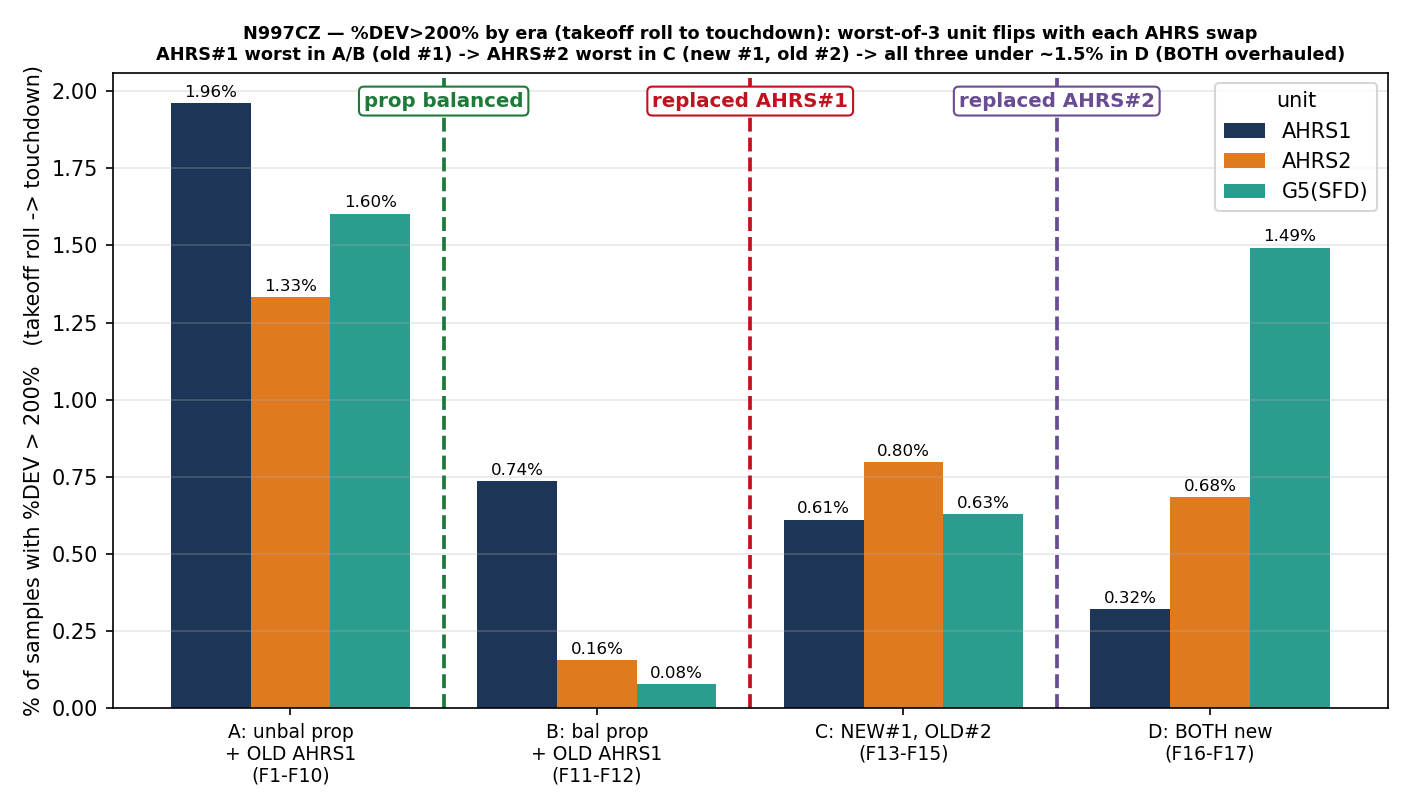
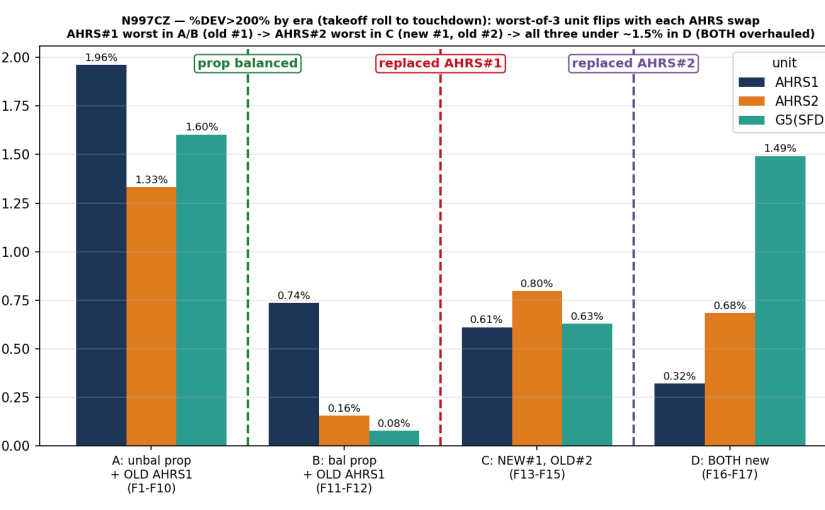
That’s the chart that tells the whole story, so let’s read it. Each group is an era: (A) original prop, original AHRS #1; (B) balanced prop, original AHRS #1; (C) balanced prop, new AHRS #1 with original #2; (D) both units overhauled — but we’re getting ahead of the story. The prop balance (A→B) drops everyone. But within every era, somebody is the outlier — and in eras A and B, it’s AHRS #1. Not just on average: AHRS #1 was the highest-deviation source on every single flight from 5 through 12. On Flight 12 it saved its best for last — in-flight re-aligns totaling almost two minutes, and a cross-source roll disagreement of roughly 136°.
Fix Two: Replace AHRS #1
Garmin agreed to overhaul AHRS #1, and the replacement unit went into the panel on June 6 — the same day as Flight 12’s fireworks. The before/after is about as clean as flight test data gets:
- In-flight re-align events (“AHRS1 ALIGN”): 350 seconds total across Flights 5–12 → zero on Flights 13, 14, and 15.
- Maximum cross-source roll disagreement: ~136° → under 10°.
- Extreme deviation excursions (>500%): eliminated.
- Attitude-horizon tumbles: Flight 13 was the first flight in the airplane’s life without one, and there hasn’t been one since.
Case closed on AHRS #1. Which is exactly what made the remaining data interesting.
The Plot Twist: The Baton Pass
Look at era C in the chart above. With the new AHRS #1 installed, the outlier didn’t disappear — it moved. AHRS #2, the original, never-serviced sister unit, became the highest-deviation source on every flight 13 through 15. The worst-of-three title passed from #1 to #2 on the exact flight the new unit went in.
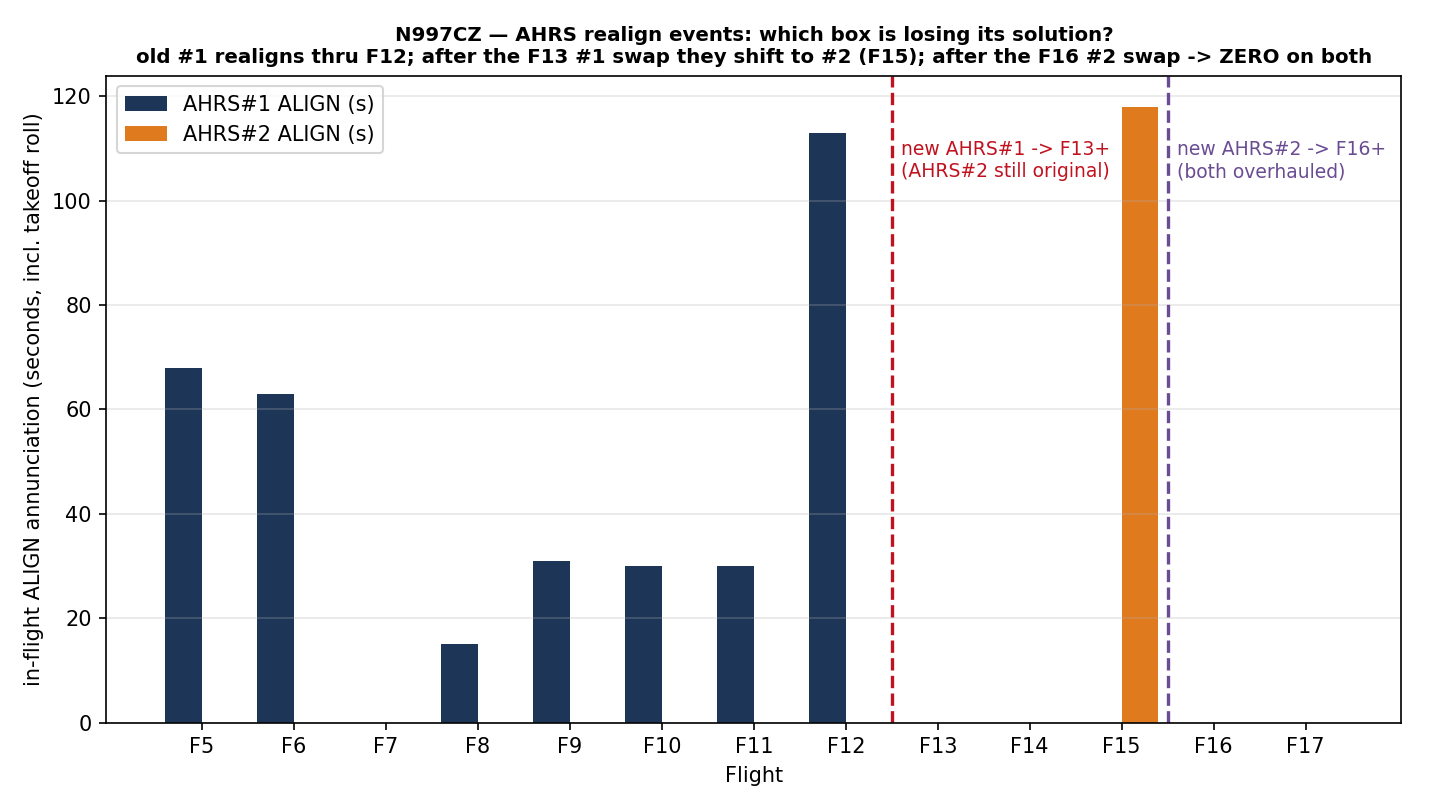
Then Flight 15 produced the smoking gun. AHRS #2 — which had never logged an in-flight re-align in the airplane’s entire history — dropped its attitude solution and re-aligned for a cumulative 118 seconds, with the system annunciating “USING AHRS1” while the brand-new #1 carried the load. The roles from Flight 12 had exactly reversed.
Better still, from a diagnostic standpoint: the failure is reproducible on demand. It triggers in high angle-of-attack, full-power slow climbs — on Flight 15 it recurred in roughly eight separate events inside a single 30-minute window of climb-performance testing, all at a median of about 89 knots, nose up, full power. A fault you can demonstrate on command is a fault nobody has to take your word for.
Convincing Garmin, Round Two
All of the above went into a short data report to Garmin — the era comparison, the re-align timeline, the reproducibility recipe — with a simple argument: AHRS #2 now exhibits the same in-flight signature AHRS #1 exhibited before its overhaul fixed it; we respectfully request the same service. The analysis we sent Garmin — since updated with the post-replacement verification data — is here, for anyone fighting a similar battle: N997CZ GSU 25C ADAHRS Deviation Analysis (PDF).
Garmin agreed. The replacement AHRS #2 is in hand.
Fix Three: Replace AHRS #2 — and the Verification
Garmin’s overhauled AHRS #2 went into the panel after Flight 15. *Flights 16 and 17 (June 13) are the first this airplane has ever flown with both attitude units overhauled* — the verification flights I’d been waiting to write about.
The data did for #2 exactly what it did for #1. Measuring only the part of each flight that counts — from the start of the takeoff roll through touchdown, with the power-on/alignment window excluded — here is the before-and-after:
- ATTITUDE / HEADING MISCOMPARE annunciation time: Flight 15 logged 346 seconds of attitude miscompare and 209 seconds of heading miscompare. Flights 16 and 17 each logged zero of both. These are the very annunciations that had survived the AHRS #1 overhaul — because #2 was still arguing — and they’re simply gone now.
- AHRS #2 in-flight re-aligns: 118 seconds on Flight 15 → zero on Flights 16 and 17, with no “USING AHRS1” reversion. AHRS #1 stays at zero too. Both boxes now hold their solution from brake release to rollout.
- Maximum cross-source roll disagreement: 0.8° on Flight 16, 3.0° on Flight 17 — against the ~136° this airplane once produced on Flight 12. No deviation tumbles on either unit.
That’s the whole arc closed. Look back at the re-align chart: the navy bars (AHRS #1) end at Flight 12, the lone orange bar (AHRS #2) stands on Flight 15, and after the second overhaul goes in at Flight 16 — nothing. Three healthy attitude opinions, for the first time in this airplane’s life.
Where It Stands
The two original cores — the unit that started it all (S/N 5Q2001016) and its sister (5Q2002262) — go back to Garmin per their return instructions, and that closes the books. Two RMAs, two overhauled units, and a flight-data trail that called the shot both times before the wrench ever came out.
The villain is retired. Onward to the rest of the Phase 1 card deck.
— with thanks to Garmin support for engaging with the data all the way through.